Products Categories
 LED Tube
Products Search
Contact Us
Tel: +86-15917453429
E-mail: info @ hellighting.com
Add: No. A333 Room, 8F Zheng Yang Building, No.1438-2 Ji Cang Rd., Baiyun Dis., Guangzhou ,zip 510410, China
How to select correct wavelength when make red therapy light |
| AUTHOR : HEL Date : 2026-08-31 15:18:11 |
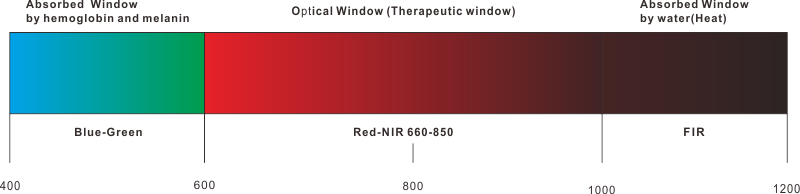
Light Window: light enters the human body 600-1100nm Let's first establish a physical fact: There is only one "window" through which light enters the human body. Not all wavelengths can penetrate into the flesh.
Those shorter than 600 nm : are strongly absorbed by hemoglobin and melanin, and blue-green light is basically consumed within 1 mm of the epidermis;
Longer than 1100 nm: strongly absorbed by water, most of the light energy becomes heat, not photochemical reaction.
The wavelength range of 600-1100 nm in the middle is called the "optical window" (also known as the therapeutic window),where hemoglobin and water are absorbed less, The 630-1064 nm wavelength used for red light therapy is all within this window. So choosing a wavelength is essentially picking a position within this window.
Key conclusion: 810/850 nm is the sweet zone - hemoglobin and water absorption are the smallest, and penetration is the deepest, which is why almost
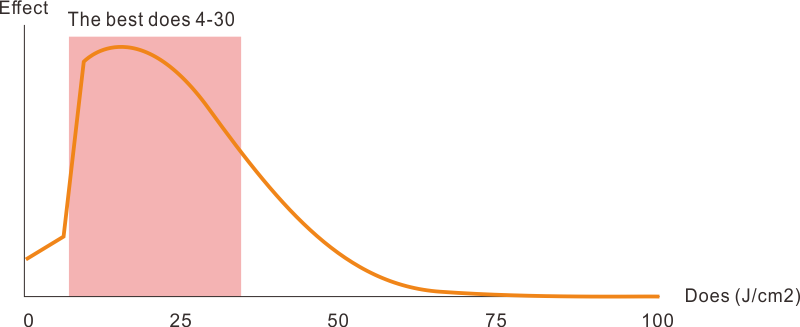
Bipolar dose-response: It's not that the higher dose is better Why 'multi wavelength ≠ more efficient': energy is shared, dose has a window
Firstly, when the total power remains constant, the more wavelengths there are, the less energy each wavelength receives. If you mark 100 W and divide it into 3 wavelengths,
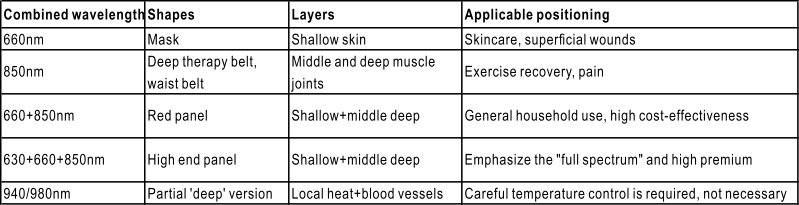
Secondly, photobiomodulation (PBM) has a "biphasic dose-response" (Arndt Schulz's law): too low a dose results in no signal, while too high a dose actually inhibits. So the core of selection is not "stack wavelength", but to make the target layer fall within the dose window - this relies on "selecting the right wavelength and providing How to combine: single/double/tree wavelengths, with different shapes
|